Tuesday, July 29, 2014

M15: Where to Gain the Edge?


This week, M15 has hit magic on-line in full force, and eager to try out the new format more than I have already at my local game store, I decided to head on-line to do battle.  This timing was fortuitous, as the modo people, in their wisdom, decided to bribe people to play on the new client with free phantom points.

It's always difficult to write about limited.  When you create an article, or a journal entry, the goal is to create something new, to explore some facet of the experience which has not been explored.  Ideas that can improve one's play in terms of general strategy are already out there, in articles, podcasts, and conversations among players.  I assume that you don't need me to instruct you in card advantage, reading signals, and other such elementary facets of limited.  Because I like to assume that my viewer is generally with it on such fundamentals, I try to approach the aspect of limited which is constantly shifting: how the introduction of a new set affects the limited meta-game.  If we assume that everyone understands the fundamentals, then the way to get ahead is to understand the new format, hopefully earlier and with greater depth than our opponents (and hey, hope to get a good draw while we're at it).

Core sets can prove challenging in this regard, as their power is driven by relatively straight-forward bombs, and often the best route to success relies on the fundamentals, rather than oddball archetypes.  But it wouldn't be very exciting if all I left you with for advice on drafting M15 was "stay open, read signals, play good cards, and pay attention to your mana curve" would it?  So, despite my sense that M15 is not a terribly synergistic set, I shall attempt to look into this format hoping to discover small edges that we as competitors can seize, and if I must discuss aspects of limited that you already understand, hopefully you can get some value as I discuss these topics in a new context.

First, we should talk a little bit about M15 sealed.  While my sealed decks are not entirely indicative of the format in general because of the inclusion of promo cards, I still learned some important lessons from these decks and rounds.  

In my first, real-life, pool, I chose red as my color.  With lightning strike as a common, this color seemed well positioned against the many black decks I would be facing, as I would (theoretically) have access to a kill spell which for a mere two mana would take care of the black promo.  Fortunately, I did have the two lightning strikes, and was fortunate to open up a Chandra as well.  Combined with a bounty of black removal spells, I was able to construct a powerful red/black control deck which would allow me to play defense until such a time as I would land my siege dragon.  


I went 4-0, including one memorable game against a red deck where I thought I was just dead to my opponents turn 2 borderland marauder. I fell down to just a few points of life, when removal spells and a timely rotfeaster maggot were able to stabilize the situation.  While wall of fire (as seen above, in its more beautiful incarnation) is never a high pick in draft, in a sealed red/black control deck it proved incredibly important as its high toughness and threat of activation proved a potent deterrent to ground-pounders.

In my second pool, I had a larger challenge, as my pool could have gone in two different directions.  Black was an obvious choice, but whether to pair it with green or blue was an unsettled question.  Here's the deck I registered: 

This deck contained a lot of raw power: card draw, removal, bombs.  However, what it lacked was a strong early game.  Simply having two strong one-drops was not enough, and against more aggressive pools, which I saw more often than I expected to, I found myself sideboarding into a speedier b/g strategy:


Featuring more creatures, and the ability to gain tempo advantage with elvish mystics (wizards, bring back our llanowar elves, please! with the freaky headgear, preferably), this deck was better able to impact the board.  Elvish mystics are worse top-decks than the blue draw spells the previous build had, but the cost of potentially drawing them late was well worth their inclusion.  Somewhat durdly two drops also added to the cohesion of this strategy by contributing to the convoke spells.  Satyr wayfinder, in particular, seems an especially juicy creature in a convoke-heavy deck, with it's ability to tap to reduce cost and find a land to play those pricey spells.  Yes, accidentally milling my garruk sucked, but you have to fight through things like that.  Additionally, the incidental lifegain present in the deck proved useful time and again as I found myself racing: four points of life from covenant combined with another 3-5 from rotfeaster maggot adds up real quick.

Despite this very strong pool, I went 2-2.  Of course, I like to console myself with the fact that my deck went 2-0 against draws which didn't contain soul of shandalar, but that's not much comfort.  Flesh to dust, garruk, and encrust were my best answers to that powerful card that my deck contained, but I just couldn't find them in time in either of the two rounds where I lost.  The soul of innistrad round, by comparison, felt like a breeze.

Going forward we won't have access to such weighted pools, and general sealed advice will be more useful.  The best sealed pools will have sufficient two and three drops as a hedge against aggro decks, while containing powerful game-swinging spells.  With six planeswalkers in the mythic slots along with the five powerful souls, you'd better either build a deck with the ability to end games before those powerful cards can unleash their full potential or be playing them yourself.



While black and red seemed very strong in sealed, I determined not to force these colors as the drafts I joined fired.  The buzz in the community is that red is one of the stronger draft colors, and given that each color has some powerful cards to recommend it, I made a point to only go red if I were receiving pronounced signals that it was open.  Spoiler alert: it never was, and the only good red cards I'd end up taking were late, third-pack hate drafts.

I was eager to explore the power of white in particular, and see if triplicate spirits could measure up to the long tradition of evasive white token makers.  Battle screech, lingering souls, spectral procession: all powerful white spells that can cause your opponent nightmares.  Even timely reinforcements was a high-pick in its day.  When my first draft presented me with a pack 1 pick 1 spirit bonds, I decided to see if I could go into a token-heavy "wide" theme.  This was the result:


With seventeen creatures (not including triplicate spirits) this deck supported spirit bonds very well.  The nice things is, spirit bonds rewards you for something you want to be doing anyway: drafting creatures.  With removal spells being in short supply, this deck made winning with creatures alone its goal.  Pump spells and favorable trading allowed it to move past the first two rounds of red decks before splitting in the finals.  The one round where I did draw spirit bonds in my opening hand, it helped me handily crush an aggro deck as it allowed me to trade more effectively.


This was a premiere, 64-person draft where a first-pick raise the alarm out of a fairly disappointing pack led to a very interesting, quite aggressive build.  This deck supported sanctified charge even better than the previous deck did.  While it easily crushed the red deck I played in the first round, I lost a real close one in round 2 where the red deck I played against managed to whittle me down with island-walking squid tokens.  Had I had one more creature on board, I would've been able to use the sanctified charge in hand to demolish my opponent from a seemingly healthy life-total.  


After that disappointing 1-1 finish, I immediately dove into another 8-4.  Pack 1 offered up a green paragon, and curious to see if I could build around it by grabbing a bunch of solid green dudes to make even better, I kind of wound up forcing green.  Honestly, I got very lucky in this draft by being passed all those juggernauts, and to open that twingrove, as I came very close to having a very bad deck.  As it was, I was able to split the finals with this deck, grinding my way through the competition.  

Although individually most of my creatures were just alright, the small synergies added up.  Even invasive species was able to help out, by unsummoning a rotfeaster maggot that had a stab wounds on it.  It is possible that unmake the graves should have been in the maindeck, considering the satyr wayfinders enabled it's strategy, but all of my opponents made strong early-game plays were it was far better to spend my mana developing my board rather than accruing card advantage.

Red is one of my favorite colors in magic.  When I first started playing the game, my best deck was an earth elemental control deck, using lightning bolt, earthbind, and fireball to try to secure victory.  Sadly, it is rare that I find myself in red in limited these days.  Even in draft formats where it is not particularly strong, it can be a very popular draft choice, as people have dreams of blasting their opponent's face, and when it is incredibly strong it almost never seems open.  Red in m15 seems to have this reputation, and for good reason: it has more than one premium common, giving it a depth it sometimes lacks.  However, for as deep as it seems, if it continues to attract multiple drafters at each table, that theoretical depth will remain just a theory.  The most powerful red deck I drafted in m14 was a red/black sacrifice deck, and in that draft I was getting last-pick act of treasons; the deck was so open that I would have been a fool to ignore it.  

My advice for m15 is to respect the power of red: draft it if you open the red soul, or chandra, but be prepare to move out or have a different color as your main, as all those lightning strikes, borderland marauders, and nightfire giants floating around will very likely create drafters who want to fight you for picks. Further, ensure that your deck has resilience to the red deck.  Packing a high number of creatures can help you against borderland marauder + lightning strike, a start which shouldn't surprise anyone given that they're both commons.

Monday, June 16, 2014

How to 2-1 a VMA 8-4 with U/R control

Vintage masters is a very exciting format.  It has stirred the drafting juices like nothing I can think of since modern masters.  I think the largest reason is the sheer depth of the format.  For whatever reason, wotc seems to think that saddling expert and core set releases with unplayable garbage is a good thing for it is "skill testing." Balderdash.  While I understand that "these cards are not for me" (I'm looking at you, ephara's radiance!) the number of unplayables that each color gets in these more common sets is very dispiriting.  When you get the pack you cracked back and your faced with a complete sea of garbage, that feels bad, but for some reason WotC seems to care less about that feel bad moment than they do the feel bad amount of having your land destroyed, your creature killed, or your spell countered.

Tangent aside, I've been doing fairly well with vintage masters: certainly better than I have with traditional expansions.  I really relish the chance to play with powerful spells, and bringing decks with a few decent creatures and many very effective spells has been proving effective.  Presenting: u/r control:


Powerful removal spells, a busted card advantage engine, and a few powerful finishers: everything I want in a control deck.  I find myself taking the cycling lands higher and higher as the depth of the format allows me to more reasonably wheel playable cards.  Certainly the velocity afforded by the cycle lands helped me consistently draw into the action of my deck - a very low-cost flood insurance policy indeed.

Round 1 I played against a mono-black aggro deck, a challenge indeed.  A choking sands slowed me down sufficiently in round 1 that I just lost.  In game 2, I stabilized at 1 life, just barely.  At 1 life, he attacked me with a death's-head buzzard and putrid imp.  In response, I cast starstorm with x=1.  I thought I had made a terrible mistake as he proceeded to discard two or three cards to make putrid imp a 2/2.  However, I was saved as his death's head buzzard proceeded to finish the 2/2 off with it's death trigger!  I never expected that my own "misplay" would prompt my opponent to misplay so badly, but with this sudden turn of events I was able to turn the game around.  While at 1 life, I was able to play a thread and hold up counterspell in the event that he would draw a burn spell off the top, and removal in case he played anything else.

Round 2 I played against white weenie, and the true power of my deck emerged.  In the screenshot below I was able to get so much value off of starfall and rescind that I felt truly dirty.  Starfall managed to nab 4 creatures, spark spray nabbed a fifth, and then rescind bounced a mistmoon griffin that he had loaded up with first empyrial armor, then a brilliant halo.


In the next game he led off with skullclamp, a very scary card indeed.  I felt a pit in my stomach as I was certain it was the very skullclamp I had passed for a kindle. Would I be finished off by my failure to hatedraft?


No way!  Timely instant removal blunted the impact of skullclamp in the very early turns, leaving him with just a benalish trapper: a poor skullclamp target indeed.  Seeing that his one creature was defensive, I decided to turn the screws to him by becoming the beatdown.  Prophetic bolt turned the race in my favor in a very card-friendly way, and once I had him on the defensive a simple counterspell was all I needed to ensure victory.  The might FTK helped too, certainly.

Sadly, my opponent in round 3 declined the split, and I found myself getting out card-advantaged by a blue-green goodstuff deck.  While future sight is a powerful draw engine, it got countersinked while his own fact or fiction resolved while I hadn't yet drawn into my counterspells.  I perhaps made a too-clever play by using aftershock to remove what appeared to be his own red source, but it would have been better served smiting his 8/8 realm seekers that he laid down the following turn.  An 8/8 was simply too large to handle and I found myself chump-blocking to death.

Still, I was happy with the strategy, my only regret not playing 18 lands in the main.  With 3 actual counterspells, I wanted more blue mana in every game 1.  Adding an island after sideboarding while taking out something mediocre definitely helped my consistency while the lonely sandbars served to help with flood issues.  Another surprise hit was spark spray.  There are a surprisingly large number of x-1s in the format, and if you come up against a deck where it has no targets, you're not down all that much because it can help you find your actual answer cards.

Good luck to you in your own drafts, and let me know if you have had similar success with control in this format.  Aggro is currently the most popular strategy, it seems to me, and I'll be curious to see if the meta evolves such that it becomes less popular.

Sunday, June 15, 2014

A vintage excursion

As I write, draft queues for vintage masters are firing at quite the rate, injecting power nine into the magic online economy, and cratering the price of force of will.  I can't say I'm too unhappy with the massive smash in prices that this set has brought, despite that diminishing the EV of vintage masters itself.  What I am happy about, however, is the chance to draft with fact or fiction as an uncommon.  Uncommon!  I've gotten a few drafts under my belt, and I have some first impressions of the format as a whole.  I'm not an amazing drafter; I'm no Ben Stark mastermind.  However, I try my best and I can definitely hold my own.

In my first draft, after cracking a mox emerald pack 1 pick 1, I decided to try and go green to take advantage of the sparkly piece of power.  While forcing green, I kept my eyes open for an auxiliary color, settling on blue when late men of war started floating my way.


I was quite happy to field this deck, as the combination of ramp, fatties, card draw and interaction seemed to be just the sort of midrange deck that would have play against a wide variety of decks.  In the swiss queue, I first faced an incredibly aggressive red black deck which demolished me in short order.  The madness value that I hoped to gain was too "cute" to weather the aggro storm I faced, by far.  Against red aggressive decks, cards like krosan tusker and ophidian seem like a sad joke.

I followed this up with an underwhelming performance against b/w value/grind.  With having mulligan issues, I was never able to gain traction against his plentiful removal spells, and creatures which entered the battlefield with strong effects.  By removing my key creatures, he was able to blank my less important ones.  Fyndhorn elves, while often strong against sacrifice effects, is less strong when you've mulliganed and need every ounce of mana you can get.  Third up in the swiss was a similar w/b control deck, splashing red for more removal.  This color combination seemed a bit awkward, and I was able to take the match down by getting my ophidian engine online.  It should come as no surprise that ophidian into man of war is a strong combination, and as my board built up steadily, simple one for one removal spells proved ineffective.


Next up was a sweet, sweet control list, featuring a grand total of 7 creatures, with a grand total of fourteen power.  And two of those wanted to be cycled for lightning rift shenanigans!  Where the r/w/b control deck I faced in the finals failed, this succeeded.  I attribute this to the two engines the deck contained of library of alexandria and lightning rift.  With a full eight ways to cycle, I found myself pinging the small threats and exiling the large ones.  White was cut off in pack 1, and I wasn't exactly sure where I was at, color wise, going into pack 2.  Pack 2 provided so much incredible white, however, that it was worth it do dive into it for a splash.  Indeed, taking as many white cards as I did proved invaluable in the draft, as I was able to win a match by siding into R/W splashing blue against fatty green monsters where the benalish trappers would shine.  One memorable game involved casting dack's duplicate on a symbiotic worm, and the swords to plowsharing the opponents worm.  This line did not lose.

I faced decks of varying aggression during each of the three rounds, and often I had my back up against the wall.  Sideboarding proved critical as memory jar would be replaced by something more relevant.  I knew that this draft hold a special place in my heart when pack 1 provided me not only with the library, but also memory jar and mind's desire.  Control in this environment is challenging, but with so many people deciding to hop on the red bandwagon, if you can preserve your life total and spend your removal spells wisely, it is possible to play the card advantage game to positive results.


After that, I felt confident enough to enter an 8-4.  I enjoy playing control; it is where my greatest strengths as a magic player lie.  With that in mind, I went in ready to play w/u control, as that seems the most effective control color combination.  At random times, I picked up very late salt flats, which meant that when a late magister of worth came along in pack three, I was able to snatch it up.  Again, I faced aggressive decks, although if anything these aggressive decks felt less powerful than those I had faced in the swiss queues!  Perhaps the growing popularity of aggro has made the card pool weaker.  In round one, I utterly crushed a red/green aggro deck with fatties.   To put it mildly, pillaging horde is not a good answer to control.  I was able to at first repel it, and then the turn after simply exile it, for a net of 2 for 5 card advantage, plus the lifegain from exile. He stole one game by killing almost my entire board with the card which deals three damage to all fliers and hitting me for exact lethal, and I sided out my fliers (magister excepted).

The next deck I saw was very interesting, a u/b build which utilized multiple clouds of faeries, thalakos drifters, and other evasive threats.  After I won game one, I found myself on the ropes in game 2, stabilizing at 1 life.  A timely swords to plowshares removed his thalakos drifters, and my thopter squadrons held off his pesky faeries.  While earlier he had used paralyze on on of my thopters, now I was able to simply let it erode away into 1/1 fliers, making his paralyze essentially a burn spell with no other value.  I decided to split in the finals, as hey, it's fathers day, and I'm going to go for a bike ride with my dad, and I wanted to get ready for that.

Vintage masters seems like quite a fun format, especially if you enjoy killing creatures.  That said, it is important to read signals and get a feel for the metagame.  Currently, aggro is enjoying a wave of popularity, but as people get a sense for how to beat them, this could change and the ability to create a killer control deck could dry up.  Staying in one color as long as possible, to both cut it off for pack 2, and to see what color is really open from the right, seems especially important.  Good luck all, and may you open a foil black lotus!

Monday, April 28, 2014

Mastering the new normal: early thoughts on the JBT format

It's been a while since my last post.  Since then, I've engaged in many disappointing x-3 ptqs, all in the 3 BNG, 3 THS pack sealed format.  Drafts have been similarly mediocre, while I've been doing well enough to get enough store credit to attend my store's prerelease entirely on that, I haven't been racking it up like I did in the era of gatecrash.  Still, I've finally started to get into a groove with this block.  Last friday night I crafted a pretty solid w/b orzhov draft deck, headlined by Brimaz, which 3-1ed, and last saturday I chose the white prerelease package and went orzhov again, this time going 5-0.  While I did get fortunate with my draft picks and sealed pulls, this record definitely has me feeling confident on the strength of these two colors going into future drafts.  Black got worse with born of the gods, but it's definitely back in the mix with journey into nyx, while white, which was never bad, continues to impress.

The draft deck, which benefited from a few born of the gods rares that people just didn't seem to want, was very resilient.  High card quality, combined with graveyard recursion (Silent Sentinel, Griffin Dreamfinder, and Whip of Erebos) meant that I was able to grind things out.  The one round I lost was to my long-time nemesis Anthony, who had a truly punishing r/w aggro deck that finished me off before I could fully gather my resources and establish board control.  Here's the list:


Creatures:

2 Nyxborn Eidolon
1 Baleful Eidolon

1 Brimaz
1 Observant Alseid
3 (!) Scholar of Athreos
1 Lagonna-Band Elder
1 Felhide Minotaur

1 Erebos' Emissary

1 Gray Merchant of Asphodel
1 Griffin Dreamfinder
1 Silent Sentinel

Spells:

1 Last Breath
1 Battlewise Valor

1 Necrobite
1 Asphyxiate
1 Read the Bones

1 Gild
1 Whip of Erebos

1 Sip of Hemlock

Clearly, black was open.  I believe there was only one other black drafter at this table, and he was able to draft a strong green-black build with 2 grey merchants.  White ended up being overdrafted, which I was able to work around by having strong white in pack 2, having cut the color off.  Of course, I reaped the rewards of my color combination, as the other white drafters, and I think there were three, weren't interested in vanilla horned turtles that scholars of athreos would have been in their decks.  During the drafting process, it was a struggle to keep the curve down, and by focusing on impactful 2 and 3 drops, I ended up having enough early game to ensure that my whip, silent sentinel, and sip of hemlock would hit play.


The sealed pool practically built itself.  Having cracked open an Athreos, I was eager to see if I could make him do work for me as the indestructible creature I knew that he secretly longed to be.  Sadly, this pool didn't have enough solid two-drops for my taste, forcing me to run the somewhat suspicious nyx-fleece ram, but that's sealed for you.  The build:

Creatures:
1 Pharika's Chosen

1 Blood crazed hoplite
1 nyx-fleece ram
1 underworld coinsmith
1 oreskos swiftclaw

1 Athreos
1 archetype of courage
1 harvestguard alseids
1 scholar of athreos

1 cavern lampad
1 dawnbringer charioteers
1 disciple of phenax

1 supply line cranes

1 silent sentinel

Spells:

1 Mortal obstinancy
1 Ajani's Presence

1 Battlewise Valor
1 Feast of Dreams

1 Read the bones
1 Spear of heliod
1 armament of nyx
1 nyx infusion


What with having Athreos, underworld coinsmith, and scholar of athreos, playing this felt like playing an athreos-theme deck.  The man himself was well-supported, many of my spells were permanents that provided him with devotion, and when you combine that with the devotion that my creatures brought (archetype of courage has two pips, yay!) he was turned on a surprisingly large proportion of time.  A temple of silence even gave me a little bit of fixing, to top it off.

One aspect that is probably worth talking about in this new format is life gain.  Incremental lifegain proved tremendously important for me all prerelease long, helping put me out of danger against the aggressive and midrange strategies I encountered.  In the final match of the night, the life I had gained from underworld coinsmith triggers, plus some attacks, a battlewise valor for two extra damage, a scholar draining for one, plus a couple of underworld coinsmith activations allowed me to close out the game with exact damage the turn before I would have died a horrible death to master of feasts.

I don't anticipate that I'll be so lucky to have such powerful rares in my corner going forward.  Despite this, white and black are together quite deep in journey into nyx.  I can see myself trying to go one of those two colors in many of my drafts, preferably both.  If white and black are both cut off?  Well, there's always my good buddy green, a color which has the advantages of being a comfortable pair to either black or white.  I'm looking forward to battling more with journey into nyx, and avoiding red like a boss.  Seriously, red in theros, what's up with that?

Sunday, February 16, 2014

BNG Pack 1 Pick 1 Exercises

So last friday night I went 2-2 with a very solid black/green deck which started out 2-0 and then lost a couple of close ones, the final round against Anthony, once again. My first pick was fanatic of Xenagos, a very solid uncommon card, but color committing.  I tried to grab red cards, as BNG has made red better, and to get a red/green beatdown deck seems a bit better in this format than in triple theros, but red was just dry.  My hunch seemed correct, as I faced Anthony's 3-0 G/R beatdown deck in round 4 (he was the last undefeated and I got paired up).  Ultimately, the fanatic of xenagos sat in the board, taunting me with its beatdown excellence.  Still, I regret nothing: the Silent Sentinel I passed up wouldn't have made the deck anyway, although it might have steered me in a radically different direction.

It hasn't all been mediocre results, though.  A couple of weeks ago, at a small BNG prerelease I went 2-0, splitting the finals with the other undefeated player (thankfully so, his removal-heavy B/R deck crushed me 2-0!).  I ended up with seven packs, and lacking a better way to use them, it seems like they might provide good examples for how a BNG-THR-THR draft might start.


Pack 1: 
Tier 1 Cards:
Drown in Sorrow
Akroan Skyguard
Hunter's Prowess?

Tier 2 Cards:
Nyxborn Wolf
Snake of the Golden grove
cyclops of one-eyed pass
nullify
revoke existence

Tier 3 Cards: 
Archetype of Endurance
Reckless Reveler
Epiphany Storm 
Evanescent Intellect
Forsaken Drifters
Black Oak of Odunos

As we flip through a pack, the first thing most of us do is sort into categories: those we like a lot, those we are fine with, and those we just don't value highly (aka: it'll wheel).  In this pack, only drown in sorrow and akroan skyguard really strike me as having a huge impact on the potential quality of my final deck, if they end up being a part of it: hunter's prowess just seems so incredibly risky to me.  I do like big burly green creatures, and hunter's prowess can prove effective with one of them against a tapped out opponent but... one voyage's end, or heavens to murgatroyd a griptide and you're effectively out of the game.  Drown in sorrow has played well for me so far, and had I drawn it in round three or four of my most recent draft it could very well have swung the tide in my favor.  My pick: drown in sorrow.  I still don't like white.


Pack 2:
Tier 1 cards: 
Pinnacle of Rage
Pain Seer
Stormcaller of Keranos

Tier 2:
Vortex Elemental
Loyal Pegasus
Weight of the Underworld

Tier 3:
Setessan Starbreaker?
Grisly Transformation
Nyxborn Rollicker
Sudden Storm
Hold at Bay
Fearsome Temper
Evanescent Intellect
Aspect of Hydra

A question mark lingers over setessan starbreaker.  It could be that auras end up being so important in this new format that it becomes a higher pick.  As it is, the weak body and conditional effect make me leery.  This pack seems weaker than the last, with the standout card being pinnacle of rage.  In a red/blue deck, stormcaller of keranos seems incredibly powerful, but not powerful enough to warrant taking over a single color spell pack one pick one.  Pain seer is a pretty mediocre bear, but like fleshmad steed adds to your black devotion, and if it gets in there even once, you'll be happy.  Getting better grizzly bears is valuable in limited, especially as Theros block hasn't provided us black drafters with a gutter skulk.  I think the correct pick here is the pinnacle, as it seems fairly easy to get a two-for-one with it, but given how much I like black I might be tempted by the pain seer.

It's worth noting that the card quality drops off pretty significantly in this pack, even more so than in the previous (fairly unexciting) pack.  I wouldn't expect to wheel a playable from this pack, and I find this happening with some frequency with born of the gods.  As a limited-focused player, it's hard to get excited by this expansion when it seems so many of its commons are limited-weak.  Of course, if I start performing better, this attitude will probably change!

Friday, February 7, 2014

Triple Theros' Last Hurrah

Tonight, I will draft born of the gods for the first time.  I am sad to see triple Theros go, as I feel like I'm continuing to improve my play and drafting style there, but ever onward.  I'm not hugely keen on the introduction of Born of the Gods, as the overall power level streaks me as being on the weak side, but if my hunch is correct, that should make prudent drafting even more helpful in navigating the inevitable packs, arriving around picks three through four, full of unexciting cards.

When last I left, I had gone 2-2, now two weeks prior.  Last week was my last chance to draft Theros and I did not want to miss it.  When I opened the pack and found an Ashiok, Nightmare Weaver, staring me back in the face it was hard not to do a little jump for joy.


I wanted to experiment outside of my green comfort zone, and this three-mana planeswalker seemed like just the card to do so.  That said, there was a keepsake gorgon right behind it, and I knew that Tony, who was sitting to my left, has a history of going black.  Resigning myself to the idea that black would be fought over during the second pack, I proceeded to just take the card and hope to cut blue and black as hard as possible, hopeful that he would at least not go blue.

Thankfully, blue and black are in this format deep enough to support two people going those two colors, even if they are sitting next to eachother.  Later, I found out that Tony had opened up a strong blue bomb (Prognostic Sphinx, if I remember correctly?) and went u/b as well.  Still, there were enough goodies to go around, as I ended up with the following list:

1 Boon of Erebos
2 Baleful Eidolon
1 Pharika's Cure
1 Voyage's End
1 Shipwreck Singer
1 Returned Phalanx
1 Wavecrash Triton
2 Read the Bones
1 Nighthowler
1 Dissolve
1 Nimbus Naiad
1 Burnished Hart
1 Ashiok, Nightmare Weaver
1 Disciple of Phenax
1 Coastline Chimera
1 Cavern Lampad
1 Thassa's Emissary
1 Prescient Chimera
1 Gray Merchant of Asphodel
1 Sea God's Revenge

It is possible, for devotion purposes, that I might have been better off running a miscellaneous black creature over the burnished hart.  With a very low mana curve, and with only two colors, it's ability was not hugely impactful.  Indeed, either the fleshmad steed, blood toll harpy, or fellhide minotaur would often come in when I faced decks where I decided adding a touch of black would matter.

Round 1 and 2 were both favorable match ups, in my opinion: red green and red white aggro, respectively.  Returned phalanx provided a huge defensive boost in both rounds, as well as such defensive all-stars as baleful eidolon and coastline chimera.  Kelly did take a game, as my removal (namely Pharika's cure) didn't match-up well against her large, resilient threats, but with enough blockers and cheap interaction I was able to secure a game three win.  I didn't document my match against Peter all that well, but I seem to recall a deathbellow minotaur suiciding in against a returned phalanx.


Round three, however, the wheels began to fall off.  To be fair, I entirely deserved to lose this round.  Once again, I played against Anthony, who has defeated me very consistently.  Indeed, looking back I have mentioned getting crushed by him multiple times in this very blog, despite it being only an infant blog.  There was not just one, but two terrible misplays in this round.  For one thing, I played a nighthowler on one of my creatures despite there being no creatures on board.  Theoretically, this was to enable my next turn disciple of phenax hitting more of his hand, but his griptide (which I had seen game one) utterly demolished this plan.  I even played well to give myself a chance, coming back to within an inch of game three, but he had enough evasion to hit me for exactly lethal the turn before I could deal lethal myself.  Needless to say, I have been mentally kicking myself for playing gray merchant before shipbreaker singer since.  Every point really does matter!

Round 4 was also an uphill battle, as Dakota used his almost mono-white deck to deal a very impressive amount of damage game one, while also gaining life through, I believe, hopeful eidolon.  Dakota's improved significantly as a player since he first started coming to the store, and has really started to understand decks on a more holistic level.  I didn't have an answer to his Heliod, at all, so I was simply fortunate to preserve my life total to the point where I could start going to work on his life total with a thassa's emissary and win before he drew the godly-threat.

At 3-1, going into the fifth round I was fortunate to play against Tony, who was the last undefeated.  There was a certain poetic justice here, as I was essentially playing against the deck that I passed.  With a win, I could potentially take first place, with a loss I would scrub out at 3-2.  In the blue-black mirror, each game proved to be a long, drawn out affair.  I took game one with a meager three points of life remaining, having been victimized by his multiple evasive three drops.  Game two, I was hardly able to deal him a point of damage.  Game three played out as I expected it would: I struggled to stabilize against his early three-mana fliers.  Thankfully, with Ashiok I was able to summon forth a shipwreck singer that my own deck refused to provide for me, which when combined with a timely sea god's revenge, finally stabilized my position at a precarious one life (albeit with gray merchant in hand).


Sadly, each of these games was such a long, drawn-out affair, that we were now in turns.  Had we infinite time, it was possible I could have used my new-found board position to finish milling his deck with Ashiok, or even take him to zero, perhaps.  Given the number of people at the tournament, I knew that there were probably enough x-1 players where even a draw would not put me into the top 5, where one receives store credit.  Scolding myself once again for losing round three due to terrible, terrible misplays, I scooped them up.

It was a sad finale for what was a strong deck, but I had to give Tony credit: his strategy did stack up well against mine, with his consistent evasive threats blanking several of my important defensive cards such as returned phalanx and baleful eidolon.  Decks of this caliber come along only every so often, and when you do get them, it is important to play conservatively, precisely, even professionally, in order to get maximum value.  Bestowing a nighthowler for no value other than to look at more cards with my disciple of phenax was precisely the sort of "tricksy" play that I should have avoided.

Born of the Gods doesn't offer a whole lot to this style of deck at the uncommon and common slot.  Drown in sorrow, certainly, bile blight even, but those are uncommons which will get taken very highly.  Really, your best black removal spells for a control style deck is probably weight of the underworld, which compares pretty unfavorably to the awesome two-punch of baleful eidolon and returned phalanx that Theros provides us.

I blue, Eternity Snare could also be good in this sort of strategy, but at six mana it is unappetizingly expensive.  At the common slot Nyxborn Triton and divination are probably the only cards that blue offers us for this strategy, once again comparing unfavorably to such sweet spells as wavecrash triton (best horned turtle ever?) and voyage's end.  Still, if enough uncommons of the caliber of siren song lyre or pillar of war find their way to you, this style could prove to be viable.

Perhaps I am being too hard on born of the gods.  The mere existence of the whelming wave/mnemonic wall combo, for example, does add something.  This really does feel like a shake-up of the format, and going into tonight's draft I really feel no strong guidance aside from that old drafting stand-by: stay open, and take the best strategy passed to you.  We shall see if I can follow my own good advice!

Wednesday, February 5, 2014

Give me the tools, and I will finish the job... maybe?

It's been an interesting couple of weeks in magic limited.  For me, it has been a series of ups and downs, with solid draft decks -almost- getting there and a prerelease where almost getting there was as good as a win.

Man is a tool-using animal. Without tools he is nothing, with tools he is all. - Thomas Carlyle 

I suppose I have been hesitant to write about the last few weeks, as they have been marked by personal disappointment.  In a way, I feel some sense of shame as I didn't do justice to the decks which I drafted.  Two weeks ago, I approached the second-to-last triple Theros draft at my lgs in the mood to splash, which meant green.  Unfortunately, the passage of time has left my memory fuzzy as to how I built my draft pool precisely.  Here is how best I reconstructed it.

1 Sedge Scorpion
2 Traveler's Amulet
2 Voyaging Satyr
2 Nylea's Presence
1 Returned Phalanx
1 Opaline Unicorn
1 Wavecrash Triton
3 Nessian Courser
2 Burnished Heart
1 Time to Feed
1 Griptide
1 Thassa's Emissary
2 Nylea's Emissary
1 Nessian Asp
1 Lash of the Whip
1 Nemesis of Mortals
1 Abhorrent Overlord

This deck seemed to me to have quite a bit of power to it.  I like to think of drafting triple Theros as a process of accumulating tools which will allow you to weather all sorts of different decks.  This deck features several of the tools I like to have: big bodies, some removal/bounce, some card draw, some ramp.  Thus, it was disappointing to go 2-2, losing some very close games.

Round 1 I played against Brian, who had drafted a very black-heavy deck.  He played good spells in the format, but his smaller creatures were just blanked by my slightly larger green dudes. At first, this was nessian courser; later, it became nessian asp.  Read the bones is a great card, but his deck couldn't seem to provide him with fatties which would rumble profitably with my board.  In game two, I noted that my bestow creatures provided me with an indomitable board presence, making up for an absent nessian asp.


Round 2 was against Kelly, were my anti-aggro tools once again came up big.  Her selesneya aggro deck featured the play of ordeal of heliod onto cavalry pegasus, but my griptide provided me with a solid answer.  Fortunately I only took two from the pegasus, and soon I had ramped out an abhorrent overlord with the ramp elements in my deck.  Game two was not representative of what her deck was capable of, I think, as she was forced to mulligan to 5.  Despite that, I was forced to two-for-one myself with sedge scorpion and time to feed to get rid of a dangerously big staunch-hearted warrior, but being on the draw with a seven card hand, I was able to overcome that card disadvantage fairly easily.

I then played against Doug.  There are two Dougs at are store, so I shall dub this Doug Doug the younger.  Sitting at 2-0, I felt hopeful that I could make this week an undefeated one, so the quick thrashing I took from his rakdos aggro deck certainly took the wind out of my sails.  Tymaret and blood-toll harpy are not singularly scary cards, but in sufficient numbers and backed up with solid removal they do the job just fine.  I did put up a fight, bringing him to three games, and close ones at that, but ultimately I stumbled in this round.  I really felt the lack of powerful, flexible cheap spells in these games: leaf crown dryad, or another sedge scorpion, would have been huge.  Even a single nylea's disciple might have made the difference.  The one game I did win was off the back of wave crash triton, a three drop, reinforcing my belief that this matchup is decided by having good early role-players.

Round 4, I was looking for revenge, and got matched up against Fletcher.  In previous games I've played against him, he's tended to go for aggro strategies, so I made a mental note of this and tried to preserve my life total accordingly.  He had drafted the blue-white heroic deck, and a solid one at that.  It leaned heavily on the whiter side of things featuring the devastating phalanx leader-evangel of heliod combination that overwhelmed me in game two.  Wishing I had a shredding winds in my board for game three, I reluctantly moved on to game three.  Here, I played as well as I could, assembling an on-board presence with my voyaging satyrs, nessian asp, and a nylea's emissary that threatened to win me the game on my next turn.  With one turn to kill me, he turned on the proverbial after-burners with a combination of battlewise valor and dauntless assault, pumping up both his wingsteed rider and his evangel of heliod tokens for exactly, exactly lethal.  As Anthony excitedly said, after the match was over, I "got fletched."  I had thought that sitting at a life-total of 16 would see me safely to the next turn.


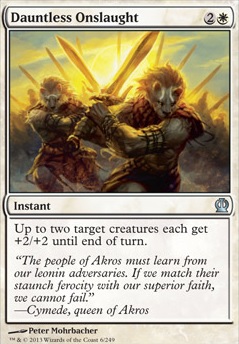
On reflection, I wish I had taken the time to recount the on board power presented once more, or called a judge.  I had originally counted fourteen, while Fletcher and a neutral observer counted 16.  Perhaps the fact that he had two bounce for what were presumably lethal left me feeling frustrated.  Still, I couldn't be too disappointed with the night as a whole.  While I didn't have a winning record, I had learned some valuable lessons about acquiring the tools to weather aggro decks in Theros, lessons which I would try to apply next week, which I shall cover in my next entry.